

Tata Nano
Tata Nano A Bold Experiment That Changed the Automotive Conversation
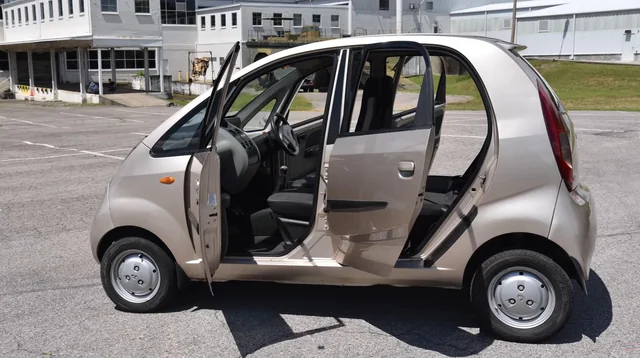
The Tata Nano was a compact city car developed by the Indian automaker Tata Motors, first launched in 2008. It was designed with the goal of creating an affordable, reliable vehicle for the masses, aiming to become the world’s most economical car. Ratan Tata, then-chairman of Tata Motors, envisioned the Nano as an entry-level vehicle for families who previously relied on two-wheelers for transport.
The Tata Nano remains one of the most talked-about cars in India’s automotive history, not because of luxury or performance, but because of the bold idea behind it. Conceived as a safe, affordable alternative to two-wheelers, the Nano was born from a vision to put millions of Indian families on four wheels. When it was unveiled, it immediately captured global attention as the world’s most affordable car, symbolising innovation driven by social purpose rather than profit alone.
Compact in size yet thoughtful in design, the Tata Nano was engineered specifically for crowded Indian cities. Its tall-boy stance ensured decent headroom, while the rear-mounted engine layout maximised interior space despite the car’s tiny footprint. For first-time buyers, the Nano offered the basics of car ownership—weather protection, improved safety compared to motorcycles, and low running costs. Its lightweight construction and simple mechanicals made it easy to maintain, especially in small towns and semi-urban areas.
Key Features and Specifications
- Affordability: Initially priced around ₹100,000 ($2,000 at the time), the Nano was marketed as the “world’s cheapest car.”
- Design and Engineering:

However, the Nano’s journey was not without challenges. Perception played a major role in shaping its fate. While affordability was its biggest strength, it was also misunderstood as being “cheap” rather than “value-focused.” Over time, changing customer expectations, stricter safety norms, and the rapid rise of entry-level hatchbacks reduced its market appeal. Despite updates and special editions, the Nano eventually exited the market.
Today, the Tata Nano is remembered as a brave experiment that challenged conventional automotive thinking. It proved that large manufacturers could innovate from the ground up, focusing on cost efficiency without completely compromising on functionality. With the growing interest in electric mobility, many enthusiasts still believe the Nano’s lightweight platform could find new life in an electric avatar. Whether or not it returns, the Tata Nano’s legacy as a car that dared to dream differently is firmly etched into India’s automotive story.
- Compact Dimensions: The Nano was ultra-compact, with a small footprint suitable for dense urban areas.
- Engine: It featured a rear-mounted, 624cc two-cylinder petrol engine, producing about 38 horsepower.
- Fuel Efficiency: The car was known for its impressive fuel efficiency, often exceeding 20 km/l (47 mpg) in urban driving.
- Weight Reduction: To keep costs low, Tata employed cost-saving techniques, such as single windshield wipers and minimalistic interiors.
- Safety and Performance:
- Basic safety features, with a lightweight body; however, it lacked advanced safety features like airbags and ABS in its early versions.
- Designed for urban commutes, not high-speed driving.
Market Challenges and Discontinuation
Although the Nano gained significant media attention and initial curiosity, it faced challenges in gaining widespread adoption. The car’s reputation as a “cheap” vehicle affected its desirability. Additionally, it faced safety concerns and encountered production challenges, including a relocation of the factory due to land disputes.
See also this: Citroën Aircross X Gets a Stronger Premium Identity
Ultimately, the Nano was discontinued in 2018 due to declining sales and changing market demands, but it remains a significant chapter in automotive history, recognized for its ambition to democratize car ownership.
Tata Nano Car Price
Tata Nano Car Price In India Start Rs 2.05 Lakh To 2.97 Lakh Ex Showroom.
Last Updated On 17, January 2026.
About the Author